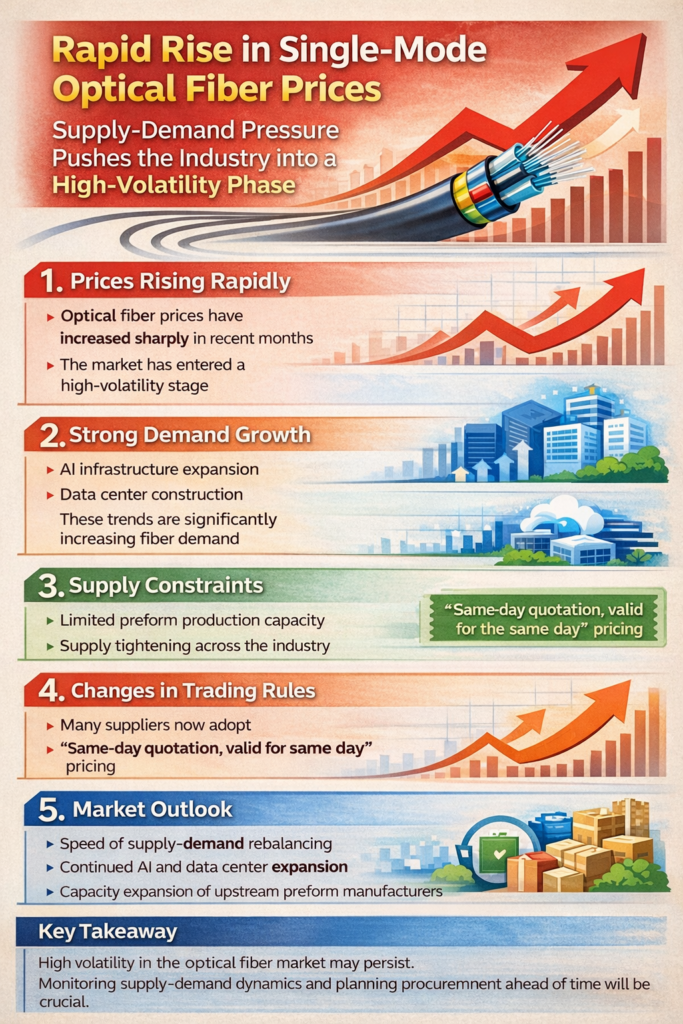
Introduction: Since the beginning of 2026, the price of single-mode fiber in the domestic market has risen significantly, with some models experiencing substantial price increases in a short period, and the market trading rhythm has also changed significantly. Recently, many industry practitioners have reported that current single-mode fiber prices are fluctuating frequently, and some suppliers have adopted a “same-day quotation, valid only on the same day” approach to cope with market changes. Behind the rapid price increase is the combined effect of multiple factors, including increased demand, upstream capacity constraints, and short-term supply-demand mismatch.
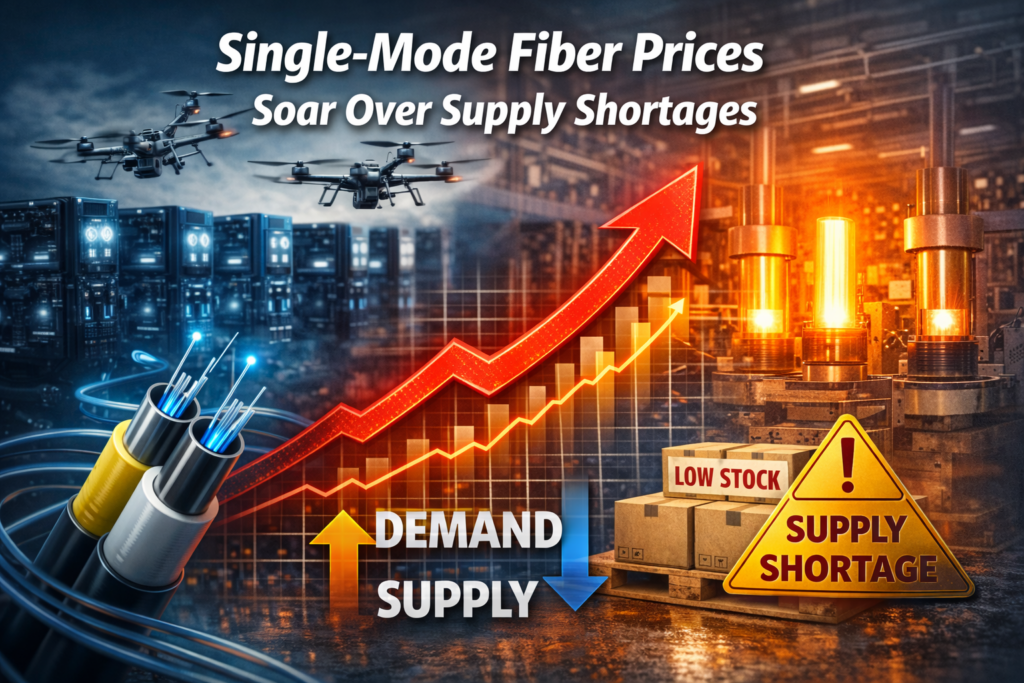
I. Single-mode fiber prices enter a rapid upward channel
In the past few years, single-mode fiber prices have remained relatively low, market competition has been fierce, and the overall profit margin of the industry has been limited. However, since the beginning of 2026, the domestic market has experienced a relatively rare rapid price increase, with prices for some common models significantly higher than before the holidays.
According to recent market feedback, different models of single-mode fiber have seen varying degrees of price increases, including commonly used products such as G.652D, G.657.A1, and G.657.A2. Due to significant market volatility, some suppliers are no longer accepting long-term price lock-in, instead relying on real-time inquiries, reflecting a clearly volatile market.
For downstream buyers, this change means increased procurement difficulty, pressure on cost control, and greater uncertainty regarding project budgets and delivery schedules.
II. Rising Demand: A Key Driver of This Price Increase
This round of price increases is primarily driven by sustained demand.
On one hand, the continued advancement of artificial intelligence, cloud computing, and data center construction has boosted demand for high-speed optical communication infrastructure. Particularly in scenarios involving large-scale computing clusters, data center interconnects, and high-density network architectures, fiber optic resource consumption has increased significantly, driving up demand for communication-grade fiber optics.
On the other hand, the demand for specific fiber optic models in certain specialized applications is also rapidly increasing, further exacerbating market tension. Unlike traditional communication network construction, this type of demand is typically characterized by concentrated release, high specification requirements, and stringent delivery times, easily creating a significant short-term pull on specific product categories.
From a market perspective, not all models are currently in short supply, but some products, especially high-specification and special-application optical fibers, are indeed experiencing supply shortages.
III. Significant Supply-Side Constraints; Upstream Preforms Remain a Key Link
Accompanying the demand growth is the issue of insufficient short-term supply elasticity.
In the optical fiber industry chain, upstream optical fiber preforms are one of the most critical raw materials and a key link affecting costs and capacity release. Preform technology has high barriers to entry, long investment cycles, and slow capacity construction, making rapid capacity expansion difficult in the short term. In the past few years, due to low market prices, the industry’s motivation to expand capacity has been relatively limited, resulting in limited room for supply-side adjustments in the face of a current surge in demand.
From the perspective of the domestic industry structure, companies with strong preform capabilities and complete industry chain advantages are still concentrated in a few leading manufacturers. For some manufacturers that rely on external raw material procurement, a tightening of upstream supply can easily lead to cost pressures, production constraints, or even temporary supply disruptions.
This is why the current market is not only experiencing price increases, but also simultaneous changes in delivery cycles, pricing power, and order stability.
IV. Changes in Market Transaction Methods Increase Short-Term Procurement Difficulty
It is noteworthy that this round of market changes is not only reflected in prices themselves, but also in changes to transaction rules.
Recently, the phenomenon of “same-day quotation, valid for the same day” and even “quotation adjustments at different times” has increased significantly in the industry. This situation was uncommon in the past, usually only occurring during periods of extreme market tension or sharp price fluctuations. For purchasers, this means that traditional price comparison, approval, and order placement processes may be difficult to adapt to the current pace, and project execution efficiency will also be affected.
Some communication engineering, network construction, and supporting integration projects have already begun to face practical problems such as material budget deviations, cost reassessment, and adjustments to procurement rhythms. For small and medium-sized customers who rely on stable raw material prices, the short-term pressure is particularly evident.
V. Subsequent Price Trends Still Depend on the Speed of Supply and Demand Recovery
From the current situation, single-mode optical fiber prices are likely to remain high in the short term.
This is because upstream preform capacity expansion is not a short-cycle operation; from equipment investment and process verification to capacity release, it often takes a considerable amount of time. Even if market demand stabilizes in the future, supply-side recovery will be difficult to fully achieve in the short term. Therefore, the current tight supply and demand situation may persist.
Of course, there are differing opinions in the market. Some industry insiders believe that the current situation is not one of “complete shortage,” but rather that high-quality supplies, specific models, and resources within suitable price ranges are even scarcer. In other words, this round of price increases is supported by both genuine supply and demand pressures and the amplifying effect of rising market expectations.
Whether prices will continue to rise or gradually stabilize depends on the following factors:
First, whether the demand from AI and data center construction continues to accelerate;
Second, whether the purchasing intensity in specific application areas remains sustained;
Third, whether the production capacity release pace of upstream preform manufacturers and leading companies improves.
VI. Facing a volatile market, advance planning is crucial for procurement and inventory preparation.
For downstream customers, simply waiting for prices to fall in the current market environment may not be the most prudent strategy. Rather than “betting on the market,” a more realistic approach is to proactively select products, plan procurement schedules, and coordinate with suppliers based on project cycles, delivery milestones, and usage scenarios.
Customers with ongoing demand for common single-mode fiber products such as G.652D, G.657.A1, and G.657.A2 should pay close attention to real-time market changes and secure resources as early as possible to reduce subsequent delivery and price risks.
As a supplier of optical fiber and optical communication products, we will continue to monitor market dynamics and provide customers with more timely product information, model recommendations, and supply support to help projects maintain stable progress in a complex market environment.
Conclusion The rapid changes in the single-mode fiber market since the beginning of 2026 are attracting attention across the entire industry chain. From rising prices to supply and demand pressures, and then to changes in trading rules, this is not just a normal price fluctuation, but also reflects the increasing strategic value of basic optical communication materials in the new round of digital construction.
In the future, with changes in demand structure and the advancement of supply-side adjustments, the market is expected to gradually find a new equilibrium point. However, before that, the optical fiber industry will likely remain in a period of high volatility and high attention.