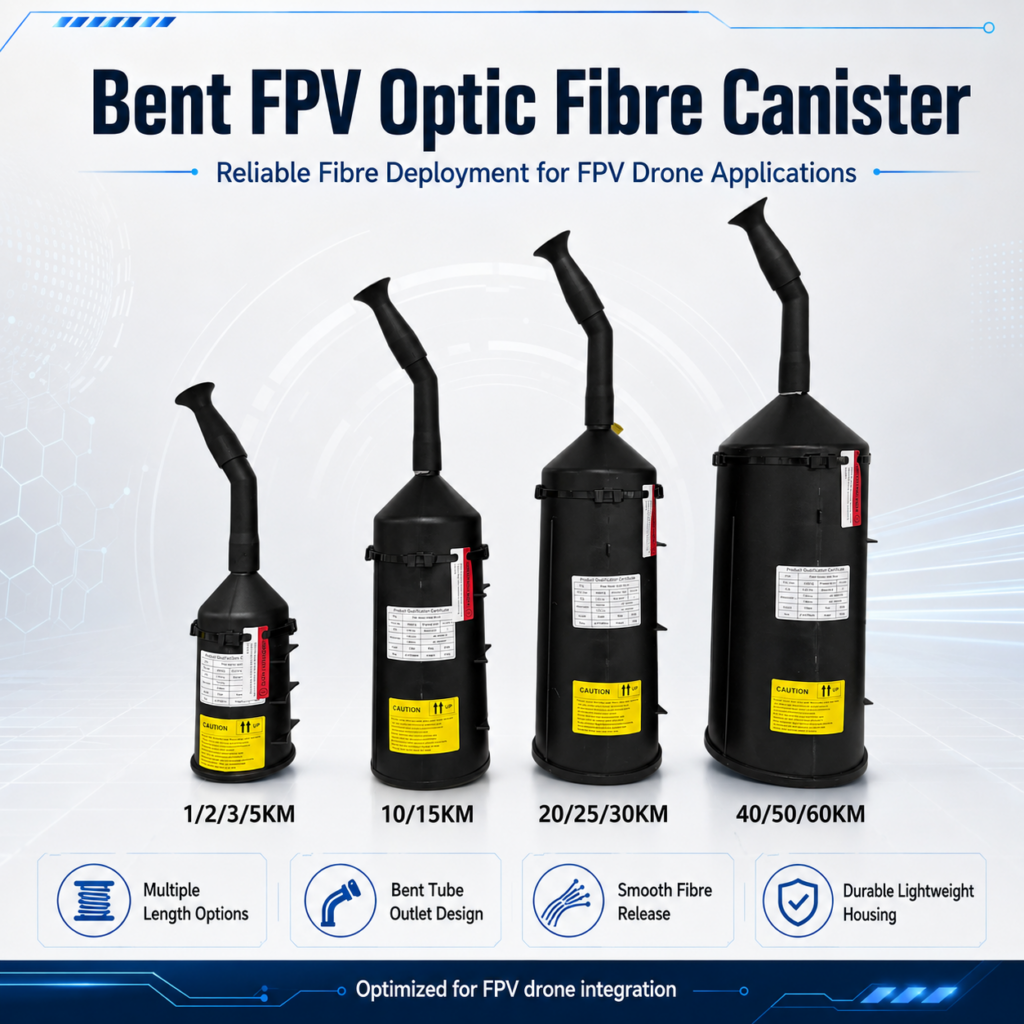
Why Buyers Are Searching for Fiber Optic Drone Systems
The drone market is full of bigger batteries, stronger motors, longer antennas, and more powerful radio modules. But one problem still appears again and again: wireless signal is never completely predictable.
That is why the fiber optic drone is becoming a serious topic for FPV users, industrial operators, inspection teams, and system integrators. Instead of relying only on radio frequency communication, a fiber optic FPV drone uses an ultra-thin optical fiber link between the aircraft and the ground side. This physical connection can carry control data, video feed, and mission data with low latency and strong resistance to electromagnetic interference.
For buyers searching terms like fiber optic drone, fiber optic fpv, fiber optic fpv drone, drone fiber optic cable, or optical fiber drone, the real question is not only “How far can it fly?” The better question is:
How stable is the signal when the environment becomes difficult?
That is where fiber optic drone technology becomes different.
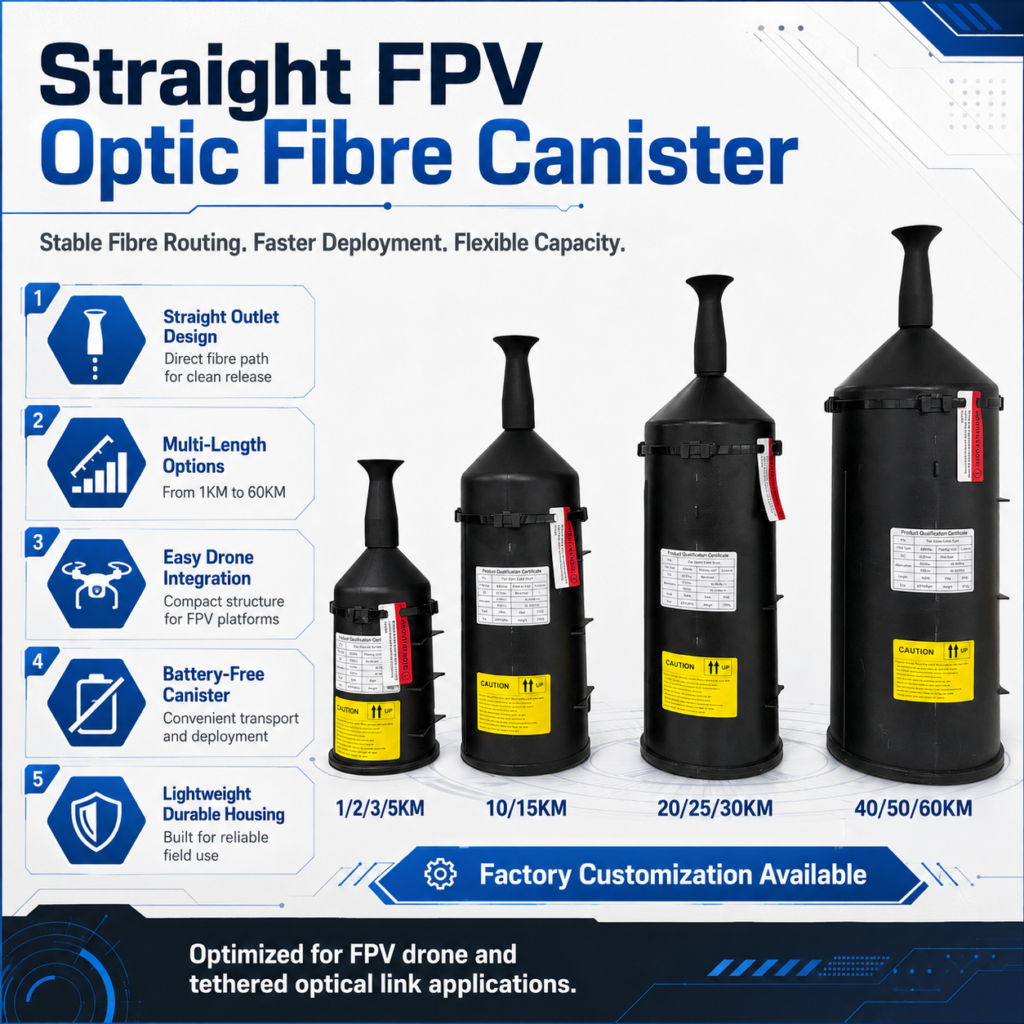
What Is a Fiber Optic Drone?
A fiber optic drone is a UAV or FPV platform that uses optical fiber cable as the main communication link. The drone carries a lightweight fiber optic spool or canister. As the drone flies, the cable releases from the spool and maintains a physical data path between the drone and the ground station.
In a standard FPV drone, the operator depends on wireless video and control signals. These signals can be affected by distance, buildings, terrain, RF congestion, electromagnetic interference, or unstable line-of-sight conditions. A fiber optic FPV system changes the communication method from wireless radio transmission to optical signal transmission through cable.
This makes the drone communication link more predictable, especially in places where normal RF systems may become unstable.
The New Way to Understand Fiber Optic FPV: Signal Certainty
Most articles talk about fiber optic drones as “long-range drones.” That is only part of the story.
The bigger value is signal certainty.
A normal FPV drone may have excellent performance in open air, but once the environment changes, the signal can become unstable. A fiber optic FPV drone is different because the communication path is physically connected. The pilot is not depending only on invisible radio waves moving through a changing environment.
For industrial users, this matters. For example, during infrastructure inspection, underground entrance monitoring, tunnel-adjacent operation, power station inspection, emergency response, or dense urban work, stable control and video feedback can be more important than maximum speed.
This is why drone fiber optic cable should not be seen as a simple accessory. It is part of the drone’s communication architecture.
Fiber Optic Drone Range: What Buyers Should Really Look At
Many users search for fiber optic drone range because range is easy to compare. You may see 1 km, 5 km, 10 km, 20 km, 30 km, 40 km, or even longer optical fiber options on the market.
But range should not be judged only by cable length.
A professional buyer should also check:
- Fiber cable diameter and strength
Thinner cable can reduce weight, but it must still release smoothly and resist breakage. - Spool winding quality
A poor spool can create drag, tangling, uneven release, or sudden fiber stress. - Bend radius control
Optical fiber is sensitive to excessive bending. A better canister design helps guide the fiber direction and reduce unnecessary loss. - Drone payload balance
A longer cable spool increases weight. The drone frame, battery, and payload must be matched correctly. - Ground module compatibility
The optical link should connect cleanly to the ground side without complicated setup.
So when comparing a fiber optic drone for sale, do not only ask, “How many kilometers?” Ask, “Can the system release fiber smoothly and keep the link stable during real flight?”
Why Drone Fiber Optic Cable Design Matters More Than People Think
The cable is the heart of the system, but the canister is what decides whether the cable can work properly in the air.
A high-quality drone fiber optic cable system should focus on controlled release. If the fiber leaves the spool at a bad angle, the cable may rub, bend, or suffer unnecessary tension. This can reduce stability and increase the risk of signal loss.
This is where product details become important:
- A guided tube can help the fiber exit in the correct direction.
- A downward tube orientation can reduce friction during FPV drone movement.
- An adjustable tube bracket can make installation easier on different drone frames.
- A built-in sky module can reduce repeated handling of fragile fiber connectors.
- A battery-free canister design can simplify transport and storage.
- Direct ground-end connection can make deployment faster.
For buyers, these small design points can be more important than a simple product photo. A fiber optic drone system is not just a spool of cable. It is a complete mechanical and optical release system.
Fiber Optic FPV Drone vs Traditional FPV Drone
| Feature | Traditional FPV Drone | Fiber Optic FPV Drone |
|---|---|---|
| Communication Method | Wireless RF link | Optical fiber cable link |
| Signal Stability | Affected by RF conditions | More stable in RF-heavy environments |
| Latency | Depends on wireless system | Low-latency physical data path |
| Range Limit | RF power, antenna, environment | Mainly cable length and spool design |
| Setup Complexity | Usually easier | Requires correct cable/spool installation |
| Payload Impact | Lower | Fiber canister adds weight |
| Best Use Case | General FPV flying | Stable link, long-range data, special environments |
The point is not that fiber optic FPV replaces every wireless drone. It does not. Traditional FPV drones are still lighter, simpler, and more flexible for many users.
But when the mission requires a more stable communication link, a fiber optic fpv drone becomes a practical option.
What Affects Fiber Optic Drone Price?
Many buyers search fiber optic drone price, but pricing can vary a lot because the system is not only one part.
The final cost depends on:
- Fiber length: 1 km, 5 km, 10 km, 20 km, 30 km, etc.
- Fiber type and coating
- Canister structure
- Built-in or external sky module
- Ground module configuration
- Connector type
- Custom bracket or mounting solution
- Drone frame compatibility
- Production quantity
- OEM/ODM requirements
A low-cost fiber spool may look attractive, but if it causes fiber breakage, unstable release, or difficult installation, the real cost becomes higher. For professional buyers, reliability and integration are usually more important than the lowest unit price.
How to Choose a Fiber Optic Drone Manufacturer
When searching for a fiber optic drone manufacturer, buyers should look beyond catalog photos.
A good manufacturer should be able to answer practical questions:
- Can the canister fit different FPV drone frames?
- What cable lengths are available?
- What is the fiber diameter?
- Is the tube direction adjustable?
- Can the system connect directly to the ground end?
- Is the sky module built in or external?
- Does the product require an extra battery?
- Can the manufacturer support custom branding, length, bracket, or module layout?
- Can they provide stable supply for bulk orders?
For distributors and system integrators, factory-direct supply is also important. A manufacturer that can adjust structure, cable length, and installation details will be more useful than a reseller with only standard stock.
Where Fiber Optic FPV Makes the Most Sense
A fiber optic FPV system is suitable when stable signal matters more than maximum agility.
Common application directions include:
1. Industrial Inspection
Power plants, pipelines, large equipment areas, and communication facilities may have complicated RF environments. A fiber optic drone can provide stable video and control data for inspection work.
2. Emergency Response
In disaster areas, wireless infrastructure may be damaged or overloaded. A physical optical link can help maintain reliable communication for short-to-medium range aerial observation.
3. Long-Range FPV Testing
For users developing advanced FPV platforms, optical fiber can be used to test stable control and video transmission over distance.
4. Research and System Integration
Universities, engineering teams, and drone solution providers may use optical fiber drone systems to test new communication architectures.
5. Specialized Commercial Operations
Some operations require stable signal in RF-congested environments. In these cases, fiber optic systems can offer a more controlled communication path.
Why “Fiber Optic Drone for Sale” Buyers Should Compare System Design
When buyers search fiber optic drone for sale, many listings may look similar. But the real differences are hidden in the structure.
Before buying, compare:
- Cable length options
- Canister weight
- Fiber outlet direction
- Tube protection design
- Bracket adjustability
- Module integration
- Ground-end connection method
- Packaging and transport safety
- Customization ability
- Bulk supply capability
A good FPV drones fiber optic cables solution should be easy to install, easy to deploy, and reliable in repeated use.
The Future of Optical Fiber Drone Systems
The future of drone optical fiber technology will not only be about longer range. It will be about better integration.
The next generation of optical fiber drone products will likely focus on:
- Smaller and lighter canisters
- Better fiber protection
- Smarter spool winding
- More frame-compatible brackets
- Built-in optical modules
- Faster ground connection
- Lower total setup time
- More customizable cable lengths
For manufacturers, the opportunity is not just selling cable. The real value is building a complete FPV optic fibre canister system that solves installation, release, connection, and transport problems at the same time.
Conclusion: Fiber Optic Drone Is a Communication Upgrade, Not Just a Cable Upgrade
A fiber optic drone is not simply a drone with a long cable attached. It is a different way to think about FPV communication.
For users searching fiber optic fpv, fiber optic fpv drone, drone fiber optic cable, optical fiber drone, or drone optical fiber, the most important buying idea is this:
Range is visible, but signal certainty is the real value.
A better fiber optic FPV system should offer stable transmission, smooth cable release, easy installation, reliable ground connection, and practical customization. That is why the canister design, tube direction, bracket structure, and module integration are just as important as the cable length.
For buyers, distributors, and system integrators, choosing the right fiber optic drone manufacturer means choosing a partner that understands both optical communication and drone installation—not just a supplier that sells fiber by the kilometer.