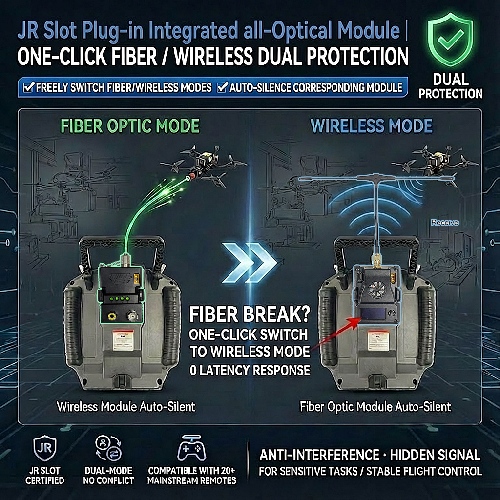
Engineers all like simple answers: one system, one solution, one “optimal solution”.
But the real usage environment of FPV never cooperates.
After years of testing in industrial zones, cities, and complex electromagnetic environments, a clear conclusion has emerged: most FPV (First Person View) losses of control are not due to equipment failure, but rather changes in the environment. And a single communication mode often assumes that the environment is “ideal”.
Wireless communication is flexible enough, but interference is uncontrollable; optical fiber communication is extremely stable, but it is not suitable for all scenarios.
The issue is not which technology is better, but rather that:
You have to bet on one risk in advance.
For professional pilots and mission-oriented users, this kind of gamble itself is a hidden danger.
Wireless interference is no longer a rare occurrence.
In the past, wireless interference was “occasional”;
now, in urban and industrial environments, it is the norm.
Picture freezing, control lag, and signal interruption often occur suddenly.
Wireless technology itself is not at fault; the problem lies in the lack of redundancy.
Fiber optics are very strong, but they are not always cost-effective.
Fiber optics have completely resolved the issues of interference and security.
However, in scenarios that require rapid adjustment and high mobility, it has instead become a limitation.
Fiber optics are suitable for scenarios that “must be stable”,
but not for those that “change at any time”.
The real problem is not dual mode but “pseudo-dual mode”.
The so-called dual-mode that requires plugging and unplugging modules and resetting is essentially still two separate systems. In competitions or tasks, every additional step of operation increases the chance of error.
If the mode switching is not fast enough, it becomes a burden.
Our mature dual-mode system achieves several things:
Fiber optics and wireless do not interfere with each other, no reconfiguration is needed for switching, and the stability of neither is compromised. It is not about having more functions, but being able to use the appropriate one immediately when needed.